
Youth Parliament Tasmania
Opening Speech
Youth Parliamentarians, distinguished guests, and friends.
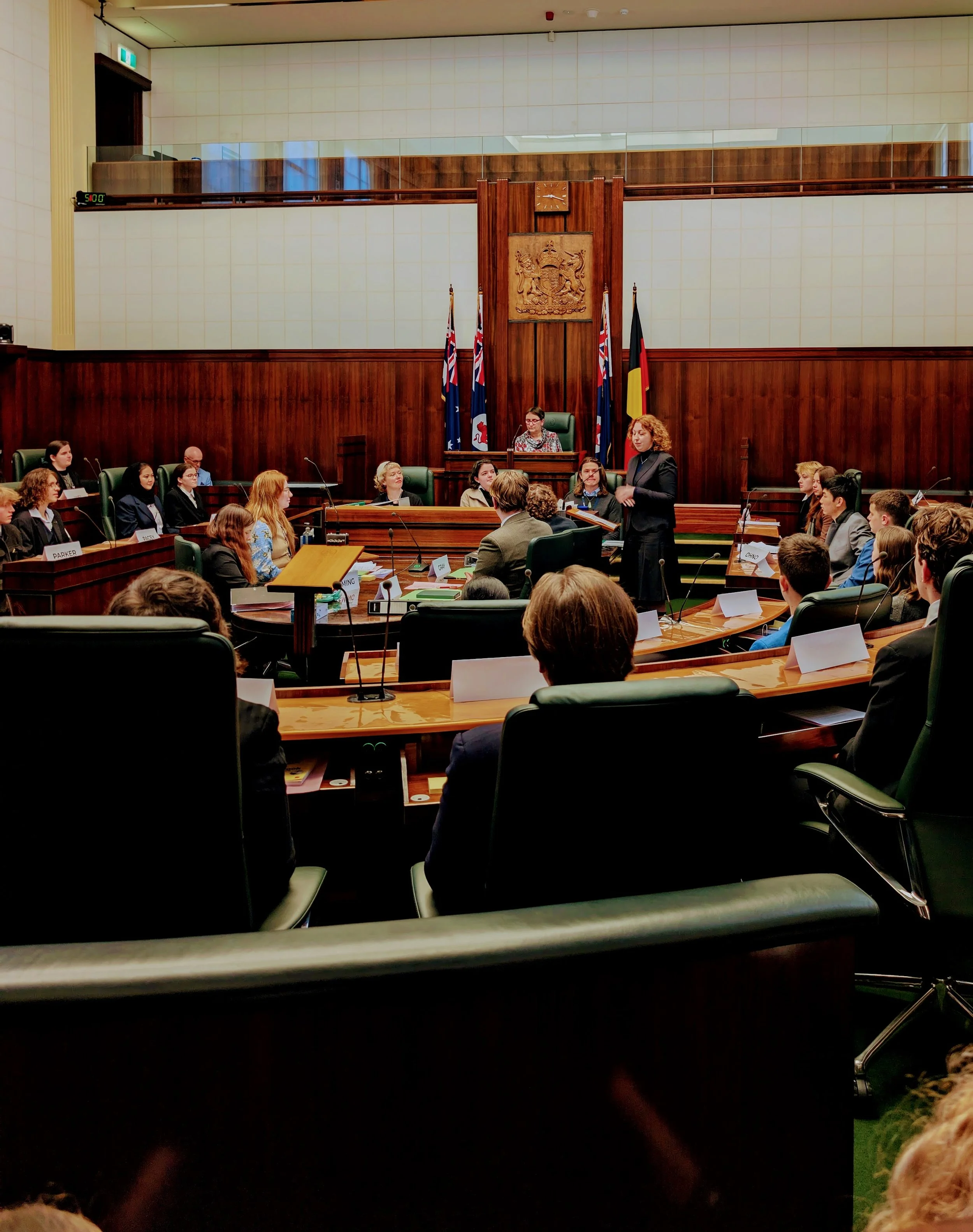
Welcome to the House of Assembly.
On ordinary sitting days, this chamber can feel like an imposing place. The deep green carpet, the polished Huon pine, the high-backed chairs, the decades of history can easily make politics feel distant – something carried out by others - perhaps older more behind closed doors or caught in sensational snippets on the evening news.
But today, on this sitting day, this chamber is transformed. It belongs to you.
Looking out across these benches, I see something vital: the true diversity, energy, and future of Tasmania. You have not come here through party backrooms, corporate interests, or privilege. You are here because you care. You are here because you have the courage to step forward, raise your voices, and claim a seat at the table.
Over the coming days, you will run the length of parliamentary life. You will table bills, move amendments, call divisions, and test your ideas against the scrutiny of your peers. You will debate pressing issues that touch the very fabric of our state – from education reform and housing accessibility to climate action, transport, and community well-being.
And as you do, remember this: your lived experience and growing knowledge matters.
When you speak on the floor of this House, you speak with the authority of young people who know firsthand the pressures facing your schools, your families, and your towns, the way you travel – or not – from place to place. You bring a clarity and fresh perspective that this parliament, and our broader society, is richer for hearing.
As Acting Speaker, my challenge and request to you today is twofold.
First, debate with passion and vigour, on the ideas that matter to you. Test every argument, examine every clause with a fine-tooth comb, and influence for the future you want to see.
Second, debate with a deep respect for your peers. True democracy is not about thinking lesser of anyone sitting on the other side of the chamber, nor shouting down your opponents or winning a soundbite; it is about the rigorous, honest exchange of ideas. It requires the courage to stand firm in your convictions, but also the humility to listen, to learn, and to work together across difference. - The strength of our parliamentary system lies not in total agreement, but in how constructively we navigate our disagreements and work together as a parliament.
The work you do here this week is not mere roleplay. The bills you debate and pass will be handed to parliamentarians and government departments. They represent real solutions to existing challenges.
When you leave this chamber at the end of the week, I hope you carry with you this thought: that your ideas belong here, that your voice matters, and that politics is not something done on your behalf, but something you have the power to shape.
And now, on behalf of the Youth of Tasmania, it is my great pleasure to officially declare Youth Parliament for 2026 open.
Cannabis Regulation:
Where I Stand
Cannabis remains the most commonly used illicit drug in Australia, and the way we respond to it as a society has real consequences for the people who use it, for police resources, and for community health. Below, I set out the facts, explain some of the terms that get confused in this debate, and outline my own position.
The facts
Use is widespread. An estimated 8.8 million Australians aged 14 and over (41%) have used cannabis in their lifetime, and around 2.5 million (11.5%) used it illegally in the past 12 months. In Tasmania, the figures are similar: around 200,000 people (42%) have used cannabis in their lifetime, and 55,000 (11.5%) in the last year.
Cannabis dominates drug arrests. Almost half of all drug-related arrests in Australia (47%) are for cannabis. Nationally, cannabis arrests have risen roughly 10% over the last decade. In Tasmania, police made 1,302 cannabis-related arrests in 2024–25.
Tasmania already uses diversion, but less than it did previously, and less than it should. Since 2000, the Police Drug Diversion Program has given officers discretion to caution rather than prosecute low-level and first-time drug users, with a three-tiered response for repeat cannabis offences that moves from a caution, to a health professional meeting, to a full treatment assessment. Over the last decade, the number of people diverted into cautions or health meetings has fallen by 58%, while the number of people prosecuted has risen by 19%.
Medicinal use has grown sharply. Medicinal cannabis was legalised nationally in 2016, and Tasmanian GPs gained prescribing rights in 2021. It's most commonly prescribed for anxiety (49% of recipients), chronic pain (43%) and cancer-related pain and nausea (6.2%). An estimated 700,000 Australians (3%) used cannabis for medical purposes in the past year, though 70% of people using it exclusively for medical reasons did so without a prescription. Why? Because it’s expensive and it can be hard for some people to find a doctor to prescribe it.
Other jurisdictions offer a model. The ACT decriminalised possession of small amounts, home use, and personal cultivation of cannabis for adults in 2020. Cannabis use there has stayed stable since — 8.7% in 2022–23, which is the same level it was in 2007. In other words, decriminalising cannabis in the ACT has not resulted in more people using cannabis. Its just resulted in less people going to court and being punished.
Public opinion is shifting. Support for legalisation nationally reached 45% in 2022–23, and 80% of Australians now believe cannabis possession shouldn't be a criminal offence at all — an all-time high. In Tasmania, a 2023 survey found 69% opposed criminalising personal possession, 85% supported a decriminalisation model with referral to treatment, and only 4% supported prison sentences. A 2025 Roy Morgan poll put Tasmanian support for legalisation at 52%, against 36% opposed.
Decriminalisation vs. legalisation: what's the difference?
These two terms are often used interchangeably, but they describe quite different approaches:
Decriminalisation removes criminal penalties for personal use and possession of small amounts, but the substance itself remains technically illegal. Instead of arrest and prosecution, a person might receive a caution, a fine, or a referral to treatment and education. Supply and possession of large amounts of cannabis typically remain criminal offences. This is the ACT model, and the model most Tasmanians surveyed said they'd support.
Legalisation removes the illegality altogether, usually alongside a regulatory framework — similar to alcohol or tobacco — covering sale, taxation, quality control and advertising. This applies to the full supply chain, not just personal possession.
In short: decriminalisation changes how personal use is penalised; legalisation changes whether the activity is illegal in the first place.
Where I stand
I've long advocated for a harm-reduction approach to illicit drugs. I see drug dependency as a health issue, not a criminal justice issue, which is why I support decriminalising personal drug use and possession, including the ability to grow a small number of plants for personal use. This is not the same as supporting legalisation of personal use, nor decriminalisation of commercial supply of cannabis – aka trafficking.
Drug dependency is generally a symptom of underlying vulnerability and disadvantage. Sanctions like convictions, fines and imprisonment tend to compound that disadvantage rather than address it. Our current drug laws create barriers to treatment, deepen stigma, and isolate the people who most need support. Responding with law and order rather than treatment sends the message that we're punishing people rather than helping them — and I believe drug dependency requires a health response.
I recognise there's a wide range of approaches to regulating cannabis across different states and countries, and that attitudes are shifting alongside the surge in prescription cannabis use. I believe it's time for a genuine community conversation about how we regulate cannabis — including whether criminalising cannabis users is the best use of police resources, and whether current laws are achieving the outcomes we actually want.
The right forum for that conversation is a parliamentary committee. A committee can hear directly from the community, from people working in health, police, justice and corrections, and from scientists and academics with expertise in cannabis's impact on individuals and the community. It can weigh all the evidence and make considered recommendations to Government on whether — and how — our approach to cannabis regulation should change.
Get in touch if you want to know more about this work.
Read my recent Media release here.
Watch - Rethinking Cannabis Laws: A Public Conversation on Health, Harm, and Regulation
Marinus Link Won't Solve
Tasmania's Energy Challenge
The latest Annual Electricity Report from the Tasmanian Economic Regulator and the recently released report of Professor Bruce Mountain, Director of the Victorian Energy Policy Centre should prompt a serious rethink of some of the assumptions underpinning Tasmania's energy future, and who pays, writes Independent MP Helen Burnet.
For years, Tasmanians have been told that Marinus Link will unlock enormous opportunities by allowing us to export clean renewable energy to the mainland at significant profit while supporting new industries at home. Yet the regulator's latest figures paint a very different picture of Tasmania's current energy position.
At a projected cost of 5 to 6 billion dollars, including associated transmission developments in the North West, Marinus Link is one of the largest infrastructure investments in Tasmania's history. The question is: will there be enough surplus electricity to justify it?
The Government's own Whole-of-State Business Case acknowledges that major industrial customers face substantial increases in transmission charges because of Marinus Link. Treasury modelling suggests additional network costs of up to $20 million per year under Stage 1, with further increases if Stage 2 proceeds. TasNetworks is expected to run at a loss for decades, copping hundreds of millions of dollars in debt.
These costs are no longer theoretical. This year's State Budget includes millions of taxpayer dollars shielding major industrial customers from increased electricity costs associated with Marinus Link, and a $170 million dollar equity injection for TasNetworks. While support is being offered to major industrials and TasNetworks, no similar protection has been promised to households and small businesses, despite the likelihood that they too will face higher network costs as the project proceeds.
Similarly, this week the Tasmanian Economic Regulator has said that our power bills will be going up by more than 4% - an extra $100 per month - when most power bills around the country are going down. The increase is in part due to the $160m in early works for the North West Transmission Development that TasNetworks will recover through an increase in the network costs in your power bills over the next 3 years.
But wait there is more. By 2029, TasNetworks want to recover over $900m for Marinus Link and related infrastructure from your power bills, which will drive up average power bills by another $50 per year, but very likely more. This is money you will have to pay, just so we can import more power for the data centres the Government is wanting to attract to the State.
The latest electricity report raises even more fundamental concerns. On-island generation fell by 10.1%, and gas-fired generation increased by more than 30%. Hydro production fell by 15% because of low flows in Hydro Tasmania’s catchments. To compensate, a record 1,967 gigawatt hours of generation was imported via Basslink. In fact, Tasmania has been a net importer of electricity for most of the past five years, exporting more than it imported only once, in 2021-22. Over the same period, hydro generation has steadily declined while gas consumption has increased dramatically.
These are not the figures of a state overflowing with renewable energy. At stake is Tasmania's clean energy reputation which rests heavily on hydro-electricity.
If Hydro is already managing generation conservatively to maintain energy security, where will the additional electricity come from to support large-scale exports through Marinus Link?
What about future industry demand on-island? The State Government is actively pursuing new energy-intensive industries like AI data centres which require vast amounts of reliable, dispatchable power operating around the clock. This will further reduce the amount of hydro-electricity available to export to the mainland.
Before Tasmania commits billions of dollars to a second interconnector designed largely around exports, there needs to be a frank discussion about whether we will actually have enough electricity to meet our own future needs.
There are positive signs. Rooftop solar generation increased by almost 13 per cent during the year, supported by thousands of new installations. Over the past four years, the number of customers with solar systems connected to the grid has increased by around 30 per cent. Much of this electricity is consumed behind the meter, reducing demand on the network and helping households to slash their own power bills.
That points towards an alternative pathway worthy of greater attention. Expanding rooftop solar, community batteries, local storage and energy efficiency measures could improve energy security, reduce reliance on gas and lower demand on the grid without requiring a multi-billion-dollar interconnector.
And yet the State Government has abandoned its interest free loans for households and small businesses wanting to install rooftop solar, while the NSW Government has announced an interest free loan for energy efficiency upgrades that even renters and landlords are eligible for. It would seemingly prefer to underwrite major industrials and GBEs than to help lower Tasmanians’ power bills.
Supporters of Marinus Link argue increased interconnection will allow Tasmania to import cheaper mainland electricity when prices are low. But that benefit must be weighed against the enormous cost of the project, the risk of higher power bills to pay for it, and the growing evidence that Tasmania may not have the renewable energy surplus that has long been assumed. The recently released report of Professor Bruce Mountain, Director of the Victorian Energy Policy Centre, concludes “Marinus Link will impose very large needless costs on electricity consumers and taxpayers.” While Saul Eslake rightly suggests Marinus Link is in the national interest, Tasmania's energy policy should begin with a simple question: how do we provide reliable, affordable and low-emissions electricity for Tasmanians first?
The latest Regulator's report does not describe a state awash with excess renewable energy. It describes a system increasingly dependent on imports, increasingly reliant on gas generation and facing growing uncertainty about future supply. That’s why I’ll be asking for transparency from the government about its energy plan, before it’s too late to turn back.
Capital Gains Tax and negative gearing reforms provide welcome relief for renters
The budget's reforms to negative gearing and capital gains tax are a welcome step toward fixing a rental market that's become unsustainable for everyone involved.
Years of generous tax incentives for landlords has created a churning market for rental properties. The numbers are startling: a quarter of landlords sell within a year, and most are gone within five. This turnover forces renters to move repeatedly, often through no fault of their own, driving up costs and creating instability.
This churn means renters have to move more frequently, often facing no-fault evictions and driving costs up even further. Meanwhile, cash-strapped landlords who've overextended themselves can't afford basic maintenance, leaving many rental properties in shocking disrepair.
These reforms won't solve the housing crisis overnight, but they're an important first step. By reducing the churn and providing renters with genuine security, we're moving toward a fairer housing market - one that works better for all Australians
Words matter, particularly in times of war
Something the Tasmanian Premier said in response to a question I asked in Parliament may have been missed by some.
After I asked a question about public service pay the Premier decided to answer the question as though he had something he wanted to put on the record.
“What we want to see is an end to the war ... [a] war which was very poorly executed with absolutely no plan,” he told the Parliament.
While this might be stating the obvious, the Premier is saying something the Prime Minister and the Federal Liberal Leader Angus Taylor haven’t had the courage to say.
In times like these, language matters.
When a world leader openly threatens to commit genocide, a war crime, because he isn’t getting his way in a misguided war of his own making, it needs to be called out.
When the best the Prime Minister can muster in response to Trump’s threat is to call it “bizarre”, we are failing in our moral and legal duty to ensure we don’t repeat the mistakes of World War II.
As the longest serving Liberal Leader in the country, the Premier’s unequivocal criticism of the war in Iran was important, even if it went unreported in the media.
I congratulate Premier Rockliff and encourage him and other leaders to go further and condemn the comments of President Trump threatening to annihilate an entire civilisation, to condemn the silence of Federal Labor and Liberal Parties on this war and these threats.
I urge the Premier to give voice to the feelings of Tasmanians – that Trump and Netanyahu started this illegal war, and it must stop immediately.
History has taught us, painfully, where indifference leads. The failure to call out acts of aggression, or threats of mass destruction is acquiescence.
If threats of mass violence are allowed to pass without firm, unequivocal condemnation from global leaders, they will not be the last.
Private Member’s Time: Climate Change motion
Parliament Calls on Government to Take Climate Change Seriously
For my first Private Member’s Time, on Wednesday 15 April, I moved a motion calling on the Government to appoint a Minister for Climate Change, and respond to the recommendations of the independent Climate Change Act review. I was pleased that the motion was supported by Labor, The Greens and most of the crossbench, and was passed.
Before the debate I spoke with a group of young Tasmanian science communicators, who told me they were pleased to see climate change being raised in the Parliament.
Pulse Tasmania: Tasmania needs a dedicated climate change minister, says Helen Burnet
Public Works Committee report on South Arm Road Upgrades
The Public Works Committee have published their report on the Rokeby Highway extension, which can be found here.
Helen’s dissenting report focusing on unnecessary removal of mature trees, Aboriginal heritage concerns and contamination risks at Ralphs Bay, is from p. 33 onwards.